Your cart is empty
You may check out all the available products and buy some in the shop
Return to shop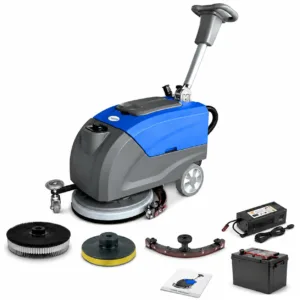
Welcome to our in-depth guide to walk-behind floor scrubbers available across Canada. If you manage a facility that demands rigorous, routine floor cleaning, a walk-behind floor scrubber can dramatically streamline your operations. Read on for a full overview of the different walk-behind scrubber types, key purchasing features, maintenance advice, and the most frequently asked questions when buying for Canadian facilities.
A walk-behind floor scrubber is an essential piece of cleaning equipment for commercial and industrial environments. These machines are designed to deep-clean hard floor surfaces such as tile, concrete, stone, and other commercial-grade flooring far more effectively and efficiently than traditional mops or smaller auto-scrubbers.
Walk-behind models offer several advantages over ride-on machines. Their compact size gives access to tighter spaces and smaller areas. They don't require dragging or steering large ride-on platforms. Their simpler manual operation typically reduces the training burden for staff. Choosing the right model helps you work smarter, clean stronger, and boost productivity.
Proper use and regular maintenance will also maximize machine performance and extend its operational lifespan. This guide covers everything you need to know—from the model types to care tips so your Canadian facility can get the most value from a scrubber.
One of the first decisions Canadian facility managers face is choosing between a walk-behind and a ride-on scrubber. Both get the job done, but they suit very different environments.
Walk-behind scrubbers are the right choice when your facility has narrow aisles, tight corners, or areas under shelving and equipment that a larger machine simply cannot reach. They are also more budget-friendly to purchase and maintain, and they require less operator training. For facilities up to roughly 20,000–25,000 sq ft cleaned per shift, a walk-behind model is typically the most practical and cost-effective option.
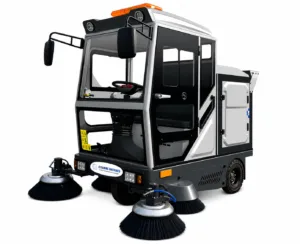
Ride-on scrubbers make more sense for very large open floor plans—think distribution centres, large manufacturing floors, or airport terminals—where covering ground quickly matters more than maneuverability. They reduce operator fatigue over long shifts but come at a significantly higher purchase price and require more storage space.
For most Canadian small-to-mid-size facilities, a walk-behind scrubber delivers the best value per dollar.
Here are the primary walk-behind scrubber types to consider for Canadian commercial and industrial settings:
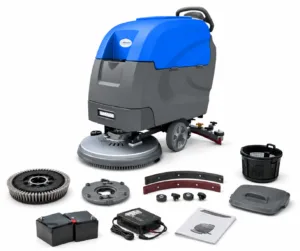
These models are built for large facilities such as warehouses, factories, hospitals, or large educational campuses. They feature wide scrub paths (often 26″/660 mm or more), large solution and recovery tanks, and high motor output to handle demanding schedules.
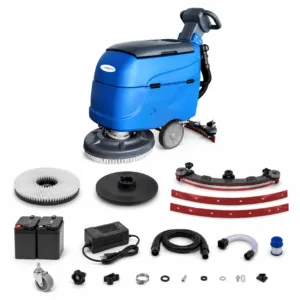
As the name implies, these combine scrubbing and drying in a single pass. A rotating scrub head lifts dirt while a vacuum/squeegee system recovers water immediately. They are ideal where quick dry times are critical, such as in retail spaces, healthcare, or high-traffic entrances.
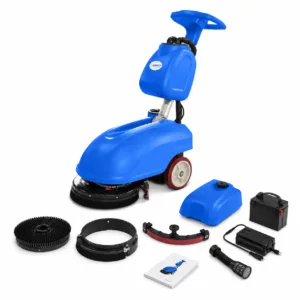
Designed for smaller Canadian facilities—like retail stores, offices, or restaurants—these units have narrower scrub paths (e.g., 17″/430 mm) and lighter weight for tighter spaces. Some are battery powered for cordless convenience, while others are corded for budget-friendly use.
Powered rather than manual, these units provide more power and longer run times. Suitable for hotels, hospitals, schools, and larger facilities across Canada, they handle heavier grime with larger tanks and stronger brushes.
For budget-savvy Canadian facilities or very small spaces, a manual (non-powered) unit can be viable. These rely on operator effort but offer an economical alternative for lighter cleaning tasks where volume is lower.
Not every facility has the same cleaning demands. Here is a quick guide to help match the right machine to your environment:
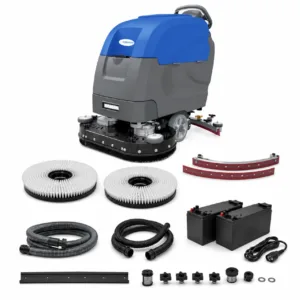
Warehouses & Distribution Centers: Large footprints and heavy forklift traffic mean grease, dust, and debris accumulate fast. Choose a heavy-duty electric walk-behind with a wide scrub path (26″ or more) and large tank capacity to minimize refill stops. The ScrubX 50 or ScrubX 55 are strong fits here.
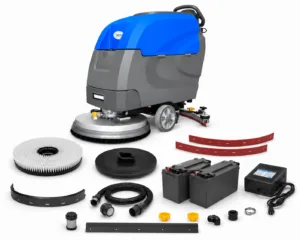
Retail Stores & Shopping Centers: Appearance matters, and floors need to dry fast to keep shoppers safe. A scrubber-dryer model is ideal — it cleans and dries in one pass with no wet floor hazard. The ScrubX 45 handles mid-size retail floors well.
Hospitals & Healthcare Facilities: Hygiene is critical. Look for models with easy-to-sanitize tanks, brush access for deep cleaning, and quiet motors for patient comfort. Battery-powered units avoid cord hazards in busy hallways.
Restaurants & Food Service: Grease and organic residue require aggressive scrubbing. Pair a stiff-brush walk-behind with a degreasing cleaning solution. Compact models work well in kitchen prep areas and dining rooms.
Schools & Universities: High foot traffic across large campuses calls for reliable, easy-to-operate machines that staff of varying experience levels can use quickly. The ScrubX 45 or ScrubX 50 offers the right balance of power and simplicity.
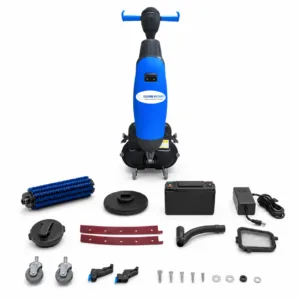
Offices & Small Commercial Spaces: A compact or manual walk-behind is sufficient for lower-traffic areas. The ScrubX 30 or ScrubX MOP is efficient, easy to store, and cost-effective for smaller square footage.
Here are some of the best walk-behind floor scrubbers from ScrubX, perfect for commercial and industrial use across Canada:
The width of the scrubbing path affects how much area you cover in a single pass. Units range from ~12 inches (for very compact spaces) up to 32 inches or more for broader coverage.
Different floor surfaces require different brush types or pads. For example, soft nylon or polypropylene brushes for coated floors; stiffer brushes for raw concrete.
Larger clean solution and recovery tanks mean longer cleaning sessions without interruption. For mid- to large-scale facilities, look for tanks in the 30-50-gallon range or equivalent.
Electric or battery walk-behind units supply more cleaning power and longer runtime. Manual units cost less but require more operator effort.
Compact units that can navigate narrow aisles, tight corners, or under furniture provide real value in constrained spaces. Check turning radius, handle ergonomics, and squeegee assistance.
Models with easily removable tanks, brushes, and squeegees simplify upkeep. Some batteries require minimal maintenance, reducing downtime and service costs.
Canada's climate creates some unique challenges that buyers in other countries simply don't face — and they're worth planning for before you purchase.
Cold storage and freezing environments: If your facility includes refrigerated or freezer areas, battery performance is a key concern. Lithium-ion batteries generally handle cold temperatures better than traditional lead-acid batteries, maintaining more consistent runtime in sub-zero conditions. Always check the manufacturer's operating temperature range before buying for cold-chain environments.
Road salt and winter grit: From November through April, Canadian facilities see heavy tracked-in road salt, sand, and grit from parking lots and entryways. This material is abrasive and corrosive — it wears scrubber brushes faster and can accelerate rust on machine components. Choose models with corrosion-resistant frames and plan to replace pads and brushes more frequently during winter months.
Hard water mineral buildup: Many regions across Canada — particularly in Ontario, Alberta, and British Columbia — have hard tap water. Using hard water in your solution tank leads to mineral scale buildup inside hoses, tanks, and spray nozzles over time. Rinse tanks thoroughly after each use and descale internally every few months using a diluted citric acid or purpose-made descaling solution to keep flow rates consistent.
Temperature during storage: Never store a floor scrubber in an unheated space during Canadian winters. Residual water in tanks, hoses, or the recovery system can freeze and crack components. Always drain all tanks completely before storing in areas exposed to freezing temperatures.
Perform daily checks: clean pads or brushes, rinse tanks after use, and ensure no debris in squeegees. Weekly checks: recharge batteries fully, inspect filters and hoses, check for wear.
Worn brushes and pads are the most common cause of poor cleaning results. Inspect pads after every 40–50 hours of use and replace them when bristles are noticeably worn or flattened. In high-grit environments—common in Canadian facilities during winter—check more frequently. Using the wrong pad hardness for your floor type also causes premature wear, so always match the pad to your surface.
For battery-powered models, avoid letting the charge drop below 20% before recharging—deep discharging shortens battery life significantly. After each shift, charge fully before storing. If the machine will sit unused for more than two weeks, store the battery at approximately 50% charge in a temperature-controlled room. For lead-acid batteries, check water levels monthly and top up with distilled water as needed.
When not in use, store the machine in a clean, dry area at a moderate temperature. Never leave water in tanks — this can lead to scale buildup.
Common problems like reduced scrub power or streaking often trace back to worn pads/brushes, dirty tanks, or clogged recovery hoses. Regular maintenance keeps issues minimal.
Walk-behind floor scrubbers are just one part of a complete facility cleaning program. Depending on your needs, you may also want to explore:
A walk-behind floor scrubber is a manually guided machine that dispenses cleaning solution, scrubs floor surfaces using rotating brushes or pads, and recovers dirty water—delivering efficient cleaning with minimal operator effort.
The unit applies cleaning solution to the floor, rotates brushes or pads to lift dirt, and then uses a squeegee/vacuum system to collect the dirty water in a recovery tank.
These machines can clean tile, sealed concrete, marble, granite, vinyl, laminate, and other hard floors. They are not ideal for unsealed wood or carpet.
Benefits include faster cleaning times, deeper scrubbing than mops, reduced labor cost, and improved safety/hygiene in your facility.
Yes—their compact size and maneuverability make them perfect for tight aisles, storage rooms, under furniture, and other confined areas.
It varies according to model, floor condition, and area size. As a general guideline, many walk-behind scrubbers clean between 6,000 and 10,000 sq ft per hour under typical conditions.
Yes—ensure no children/pets are in the area, be cautious on ramps or slopes, avoid excessive water that may cause slip hazards, know how to stop the machine quickly, and wear closed-toed non-slip footwear.
Most walk-behind models are simple to learn—with basic training, your staff should be comfortably operating one in under an hour.
If your facility requires regular cleaning — more than a few times per month — buying is almost always more cost-effective in the long run. Rental makes sense for one-off deep cleans, post-construction cleanup, or if you want to trial a specific model before committing to a purchase.
With proper maintenance, a quality walk-behind scrubber typically lasts 5–10 years. Battery life is often the first component to degrade—most batteries need replacement every 3–5 years depending on charge cycles and care.
Yes, epoxy floors are one of the best surfaces for walk-behind scrubbers. Use a soft- to medium-brush or pad to avoid scratching the coating, and avoid highly acidic cleaning solutions that can dull the epoxy finish over time.
Yes—ScrubX ships walk-behind floor scrubbers to facilities across Canada, including remote locations. Contact us for delivery timelines and freight options to your province.